
For many gym enthusiasts, developing their glutes—including their underbutt—is a top priority. And for good reason—a well-toned underbutt can make your booty pop and alter the appearance of your derriere.
But how can we construct them efficiently? It might be confusing to choose which training program to use online because there is so much contradictory information available.
Fortunately for you, we’ve uncovered the top workouts you can start using in your workout regime right away to begin developing that underbutt.
FIRST, WHERE IS THE UNDERBUTT?
The underbutt, also known as the glute-ham tie-in, is the region beneath your butt where your glutes meet your hamstrings.
There isn’t additional muscle present; this is simply the point where the two muscles converge to create the “crease.”
Generally speaking, if the crease grows larger the glutes are also bigger.
The appearance of this area is also influenced by genetics. Your genetics determines where to store fat and where your muscles are stored, so they can either work for you or against you.
In either case, strengthening the hamstrings and glutes is the best course of action for developing the underbutt area. We must focus on the lower glutes and the hamstrings in order to target the underbutt.
ANATOMY OF THE BUTT
Three muscles make up the gluteal area.
GLUTEUS MAXIMAS
The largest and most exposed of the three muscles is the gluteus maximas. Due to its size, it is mostly to blame for the shape of the bum.
Hip extension, or opening up the hip joint such that the angle between the pelvis and thigh increases, is the primary function of the maximas. Yet, it also helps with external rotation and abduction.
The gluteus maximas is the only muscle that makes up the lower glutes.
GLUTEUS MEDIUS
The second-largest of the three muscles, the gluteus medius, is situated at the sides of the upper buttocks beneath and above the maximas.
The primary function of the medium is abduction, or shifting the thigh away from the body’s center line. It also helps with toe-pointing outward hip external rotation.
GLUTEUS MINIMUS
The smallest of the three gluteus muscles, the gluteus minimus is situated deep within the posterior hip area, beneath the medius. The minimus’ function is to support external rotation and abduction.
Now let’s discuss the best exercises to target the lower glutes and hamstrings. These exercises will aid in growing your crease and thus growing your gluteus maximas.
HERE ARE THE 8 BEST LOWER GLUTE EXERCISES
When it comes to targeting the lower glutes to build the underbutt, here are eight effective exercises you can incorporate into your workout routine:
1. HIP THRUST
The hip thrust or the exercise that helps improve sex as some like to call it is at the top of our list since we now know that the best method to target the lower glutes is to conduct activities that require a hip extension.
The only hip extension involved in the Hip Thrust workout. It’s a fantastic practice that focuses on the precise area we want to target and address.

How-To Do Hip Thrust
- Place your upper back against a bench, with your feet flat on the ground and knees bent.
- While your back rests against the bench, lift your hips off the ground, squeezing your glutes at the top, then lower back down
- Repeat.
2. BULGARIAN SPLIT SQUATS
The Bulgarian split squats are quite difficult. The glutes, quadriceps, hamstrings, and calves are all precisely targeted by this advanced exercise, which is a compound movement. The unilateral component of this exercise, like the reverse barbell lunge, can assist correct any muscle imbalances and engages extra muscles required for balance.
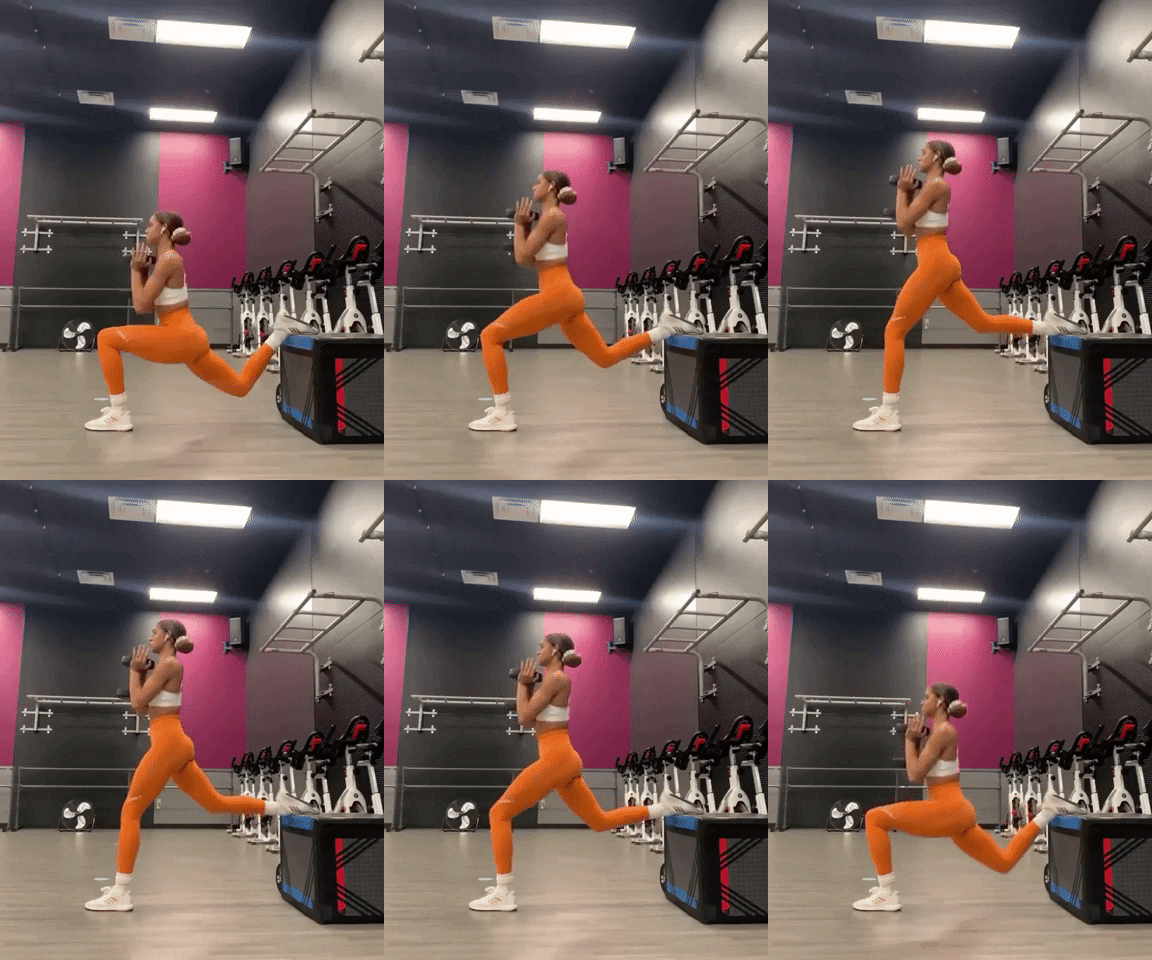
How-To Do Bulgarian Split Squats
- Stand in a staggered stance with one foot elevated behind you on a bench.
- Bend your front knee and lower your body down into a lunge position, emphasizing the glutes in the front leg.
- Repeat on both sides.
3. GLUTE BRIDGES
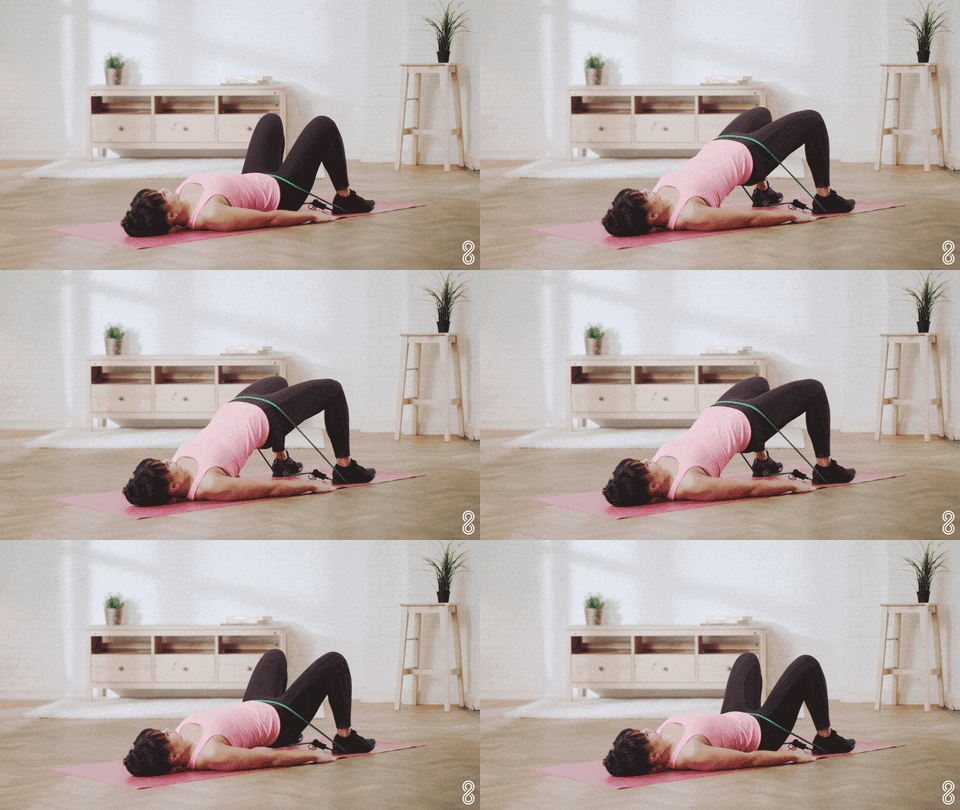
How-To Do Glute Bridges
- Lie on your back with knees bent and feet flat on the ground.
- Push through your heels, lift your hips towards the ceiling, and squeeze your glutes at the top.
- Lower back down and repeat.
4. CABLE PULL-THROUGHS
Not everyone enjoys hip thrusting. Some of the difficulties people have include back pain, discomfort with the bar across the hips, and difficulty engaging the glutes over other leg muscles. If that describes you, it would be wise to try a great hip thrust substitute like the cable pull-through.
Although the exercise is performed standing up rather than on the ground and uses cables rather than a barbell to develop the glutes, the technique is remarkably similar to the hip thrust.
How-To Do Cable Pull-Throughs
- Set up a cable machine with the cable between your legs.
- Stand with your feet shoulder-width apart, hinge at the hips, and let the cable pull your hips back.
- Thrust your pelvis forward, squeezing your glutes, and return to the starting position.
5. ROMANIAN DEADLIFTS
The Romanian deadlift is a great workout that simultaneously works the hamstrings and glutes (the two muscles responsible for the underbutt). This exercise targets both the glutes and the hamstrings because the knee is held in place, which is exactly what we need it to do.
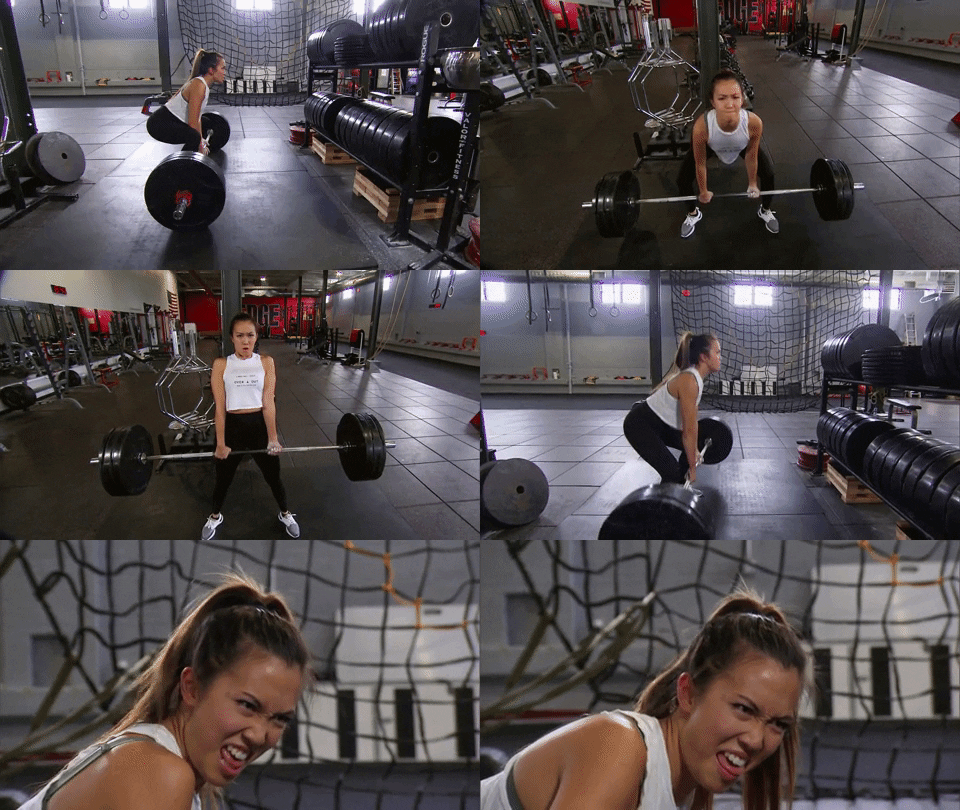
Hold a barbell or dumbbell with an overhand grip in front of your thighs. Hinge at your hips, keeping your back straight, and lower the weight towards the ground. Squeeze your glutes as you stand back up.
6. STEP-UPS
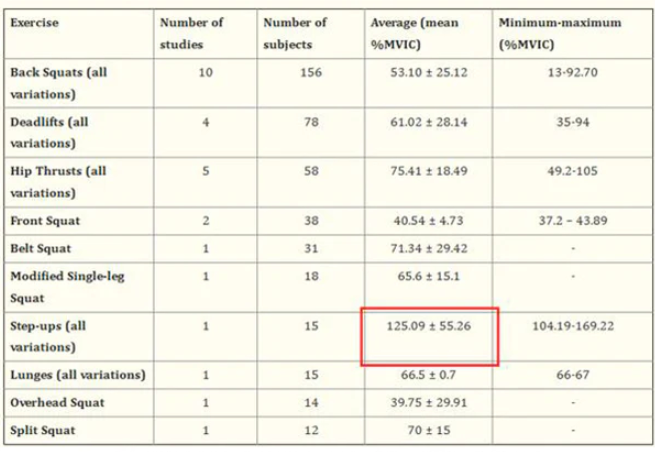
Step-ups may not have crossed your mind when planning your glute exercises, and we don’t blame you since the exercise’s simplicity can easily lead us to believe it isn’t that effective.
Based on a 2020 study that compared glute activation across 10 different exercises Step-Ups were in the lead for average glute growth. Have a look at the chart created by Robor Fitness
How-To Do Step-Ups
- Stand in front of a knee-high platform or step.
- Step up with one foot, pushing through your heel and focusing on using the glutes to lift your body up.
- Step back down off the platform with the same leg that you step up with.
- Repeat on both sides.
7. REVERSE LUNGES WITH BARBELL
You would believe that the reverse barbell lunge is an exercise that predominantly works the quadriceps, and you would be correct if you were considering the classic forward lunge. The advantage of the reverse lunge is that exercise emphasizes the glutes and hamstrings more than the quadriceps.
Due to its unilateral nature, it’s a fantastic compound exercise that can assist correct any muscular imbalances.
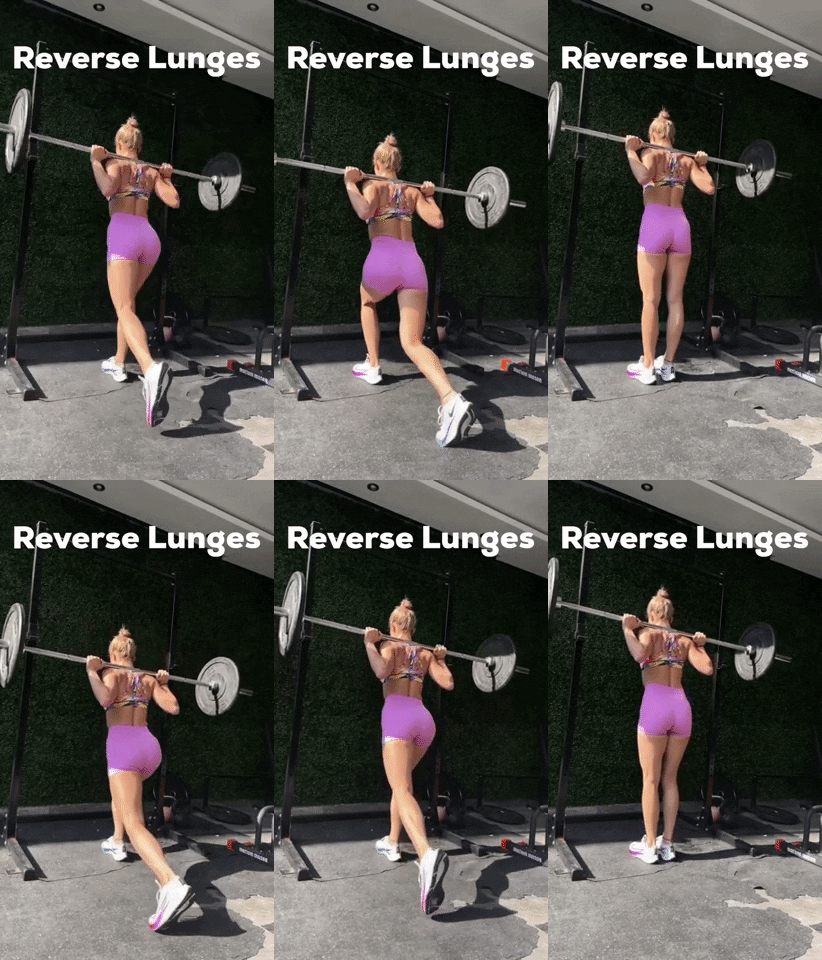
How-To Do Reverse Lunges:
- Position the barbell so that you can perform squats (shoulder height).
- Go under the barbell with a sturdy foundation, much like you would while performing squats, and raise the bar off the racks.
- Step backward gradually to give yourself room to perform the exercise without bumping into the rack.
- Lift one foot off the ground and lunge backward as far as you can safely while keeping your feet shoulder-width apart.
- Drop the hips toward the floor while bending the leading leg.
- You have completed the rep when your glutes and quads start to feel stretched.
- Return to the starting position by pushing through the front leg’s heel.
- Repeat with the same leg 5x then do the same exercise on the other leg.
8. CABLE GLUTE KICKBACK, ONE LEG AT A TIME
Another great exercise for focusing on the lower glutes is the single-leg cable glute kickback. Since it uses cables instead of free weights, the workout provides a different resistance profile that can aid stimulate muscle growth.
How-To Do Single-Leg Cable Glute Kickback:
- Position the cable machine so that it starts at the bottom. the single-leg attachment was fastened
- Face the machine, fasten the ankle strap, then go back until you feel the cable strain.
- Lean forward and keep your hands on the device. Knees slightly bent
- Push the leg back while keeping the opposing foot flat on the ground by tightening your glutes.
- When the back and hamstrings align at the peak of the movement, you can go back to the beginning position.
Remember to focus on proper form and gradually increase weights or resistance as you progress. It’s also essential to maintain a balanced workout routine that targets all muscle groups for overall lower body development.
HOW TO MOLD YOUR UNDERBUTT
We are now aware of the best exercises for targeting the underbutt and have some underbutt workouts, but how can we make sure we get the most progress possible?
CONTINUOUS OVERLOAD
Progressive overload is a training strategy that must be used if we are to grow stronger in building muscle.
Progressive overload is the process of gradually increasing the stimulation applied to a muscle in order to drive it to continuously adapt. If we didn’t do this and maintained the same stimulus, the body wouldn’t perceive any incentive to alter and would remain unchanged.
Progressive overload can be used in a variety of contexts, such as:
- Adding on more sets
- Adding on more reps
- Fewer rest periods
- Increasing weekly output
However, the approach that is used the most frequently is to raise the resistance. Since size and strength are strongly associated, if we can get stronger, we’re probably adding muscle.
DIET
We must first choose whether we want to shed fat first or build muscle first.
It could be worthwhile to lose weight before attempting to gain muscle if our body fat percentage is rather high. This is done so that when we do gain muscle, we will really be able to see it and it won’t be hidden behind fat. Moreover, fat will undoubtedly be added when we gain muscle, so if our fat percentage is already high, we don’t want to raise it.
We must consume fewer calories each day than we expend in order to lose weight. On the other hand, if we want to gain muscle, we need to consume more calories each day than we expend.
CONSISTENCY
We can’t expect results right away because both muscle growth and fat loss require time. Before we see results, we need to be dependable in the kitchen and exercise for a few months.
Having a workout partner can help with this, or you can join the communities of calorie-counting apps to meet people.
ACTIVATION OF GLUTES
Many of us spend the majority of the day seated. Being in this position for an extended period of time can cause the glutes to become weak and relaxed, whether it is when working at a desk or just unwinding at home.
In order to make sure that the glutes are active, firing appropriately, and prepared to bear the resistance used in our workouts, we must thoroughly warm them up before any activity.
If we do not work to activate the glutes properly, we run the danger of injuring ourselves because other muscles may overcompensate to try and take the burden off the glutes.
Our top workouts for activating the glutes are:
- Seated abduction
- Stairmaster
- Glute bridges
- Clam Shells
We advise purchasing resistance bands, if you don’t currently have any.
FINAL TAKEAWAYS
It IS feasible to construct the underbutt. We’ll need to stick with it, use the best exercises, and follow the fundamental rules of muscle building.
We hope you can incorporate the concepts and practices covered in this article into your workouts to develop the desired underbutt.
As usual, have fun exercising! Please leave any questions in the comments section, and we’ll get back to you as soon as we can.








+ There are no comments
Add yours